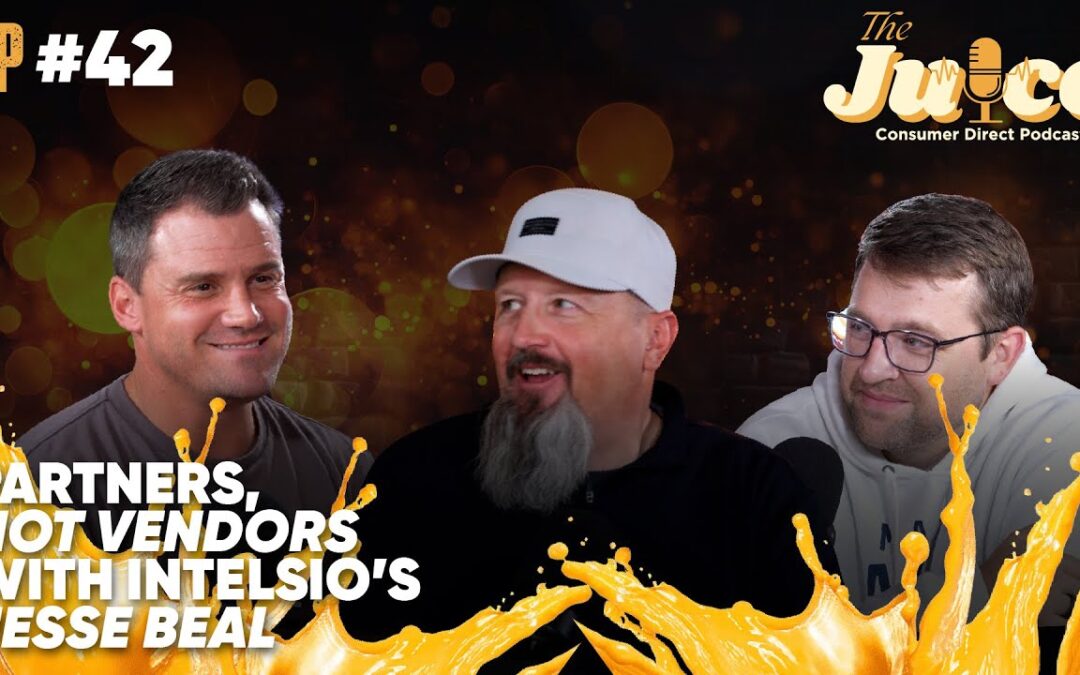
Jesse Beal built a $500M-revenue affiliate operation at Progrexion, then co-founded Intelsio to do it differently — boutique, performance-only, and structured so his agency's success is inseparable from the client's KPIs. The result: clients who hand over unlimited budget as long as the CPA target holds.
Listen wherever you get your podcasts
Key takeaways
- A performance-only affiliate model — where agency margin comes from the CPA spread, not retainer size — aligns incentives completely with client success.
- Byte scaled from zero to a $1.1 billion transaction in just over two years, partly by doubling affiliate spend while competitors pulled back during COVID.
- Clients with unlimited budget 'at target' scale far faster than those with fixed retainer spend caps.
- Intelsio maintains only 15–18 clients at a time and declines more prospects than it accepts to protect delivery quality and agency reputation.
- High-growth affiliate verticals right now include telehealth, women's health/HRT, weight-loss injectables, hearing aids, and legal intake via IVR and live transfer.
- Trust is built (or destroyed) in the first 72 hours of onboarding; early wins and transparent commitments set the entire partnership trajectory.
- Treating the relationship as 'us vs. the problem' rather than 'us vs. the client' is the cultural shift that turns vendors into true growth partners.
A Performance-Only Affiliate Model That Flips the Agency Relationship
Jesse Beal spent 15 years at Progrexion/Credit.com scaling affiliate and partnership marketing to half a billion dollars in annual revenue and 3,800 employees. When he left to co-found Intelsio with business partner Anna — who brought 20 years of affiliate experience of her own — they built the agency they wished had existed: boutique, performance-compensated, and fully accountable to client KPIs rather than retainer size.
The Bite Case Study: Doubling Down During COVID
Intelsio’s flagship early client was Byte, the direct-to-consumer clear-aligner brand. Beal was brought in as an advisor and affiliate program builder when Byte was still at zero. The playbook: align the affiliate program tightly to Byte’s growth metrics, and — critically — lean in when competitors like Invisalign and SmileDirectClub pulled back their marketing spend during COVID.
- While competitors went dark, Byte doubled its affiliate spend and captured share.
- The reduced competitive pressure made acquisition dramatically more efficient.
- Byte went from zero to a $1.1 billion transaction in just over two years, self-funded.
How the Performance-Only Model Actually Works
Intelsio keeps its retainer deliberately small. Margin comes from the spread between what a client pays per acquisition and what Intelsio pays affiliates — so the agency is structurally motivated to hit the agreed CPA or CAC target, not to inflate spend or hours.
- Single northstar KPI: Every engagement aligns on one number — CPA, CAC, cost per call, or cost per lead.
- Unlimited budget at target: Clients routinely tell Intelsio “if you’re hitting the number, there is no budget cap.”
- Skin in the game: When performance dips, Intelsio absorbs the risk — not the client.
- 15–18 clients maximum: Selectivity keeps the team’s attention undiluted. They say no more often than yes.
Where Affiliates Win Right Now
Beal points to several high-velocity verticals where performance affiliate programs are producing meaningful scale: telehealth, women’s health and HRT, weight-loss injectables, hearing aids, and legal intake (pre-qualified via IVR, then live-transferred to buyers). Across all of them, the conversion event may be a purchase, a qualified lead, or a live call — but the CPA commitment stays the same.
Winning the First 72 Hours of a Client Relationship
Both Beal and Squeeze SVP Jacob Thorpe emphasize that trust is built — or lost — almost immediately after signing. Intelsio’s kickoff playbook for a new women’s-health client (Wisp) illustrates the approach:
- Bring the full team — partner, tech, and executive — to the first call to signal depth of support.
- Commit to specific deliverables: weekly calls, pipeline visibility, approval on all creative.
- Align on KPIs and economics in that first meeting, then step back and operate.
- Stack early wins on days one, two, and three; communicate them proactively.
“Us vs. the Problem” — Not Us vs. the Client
A recurring theme across both Intelsio and Squeeze is reframing the agency-client dynamic. When incentives are truly aligned to a shared northstar metric, the relationship stops being adversarial. As Beal puts it, the goal is for the client to never want to leave — because as long as the CPA holds, there’s no reason to.
Squeeze mirrors this internally: incentives cascade from executive level all the way to individual agents, so every decision traces back to making agents more productive and clients more successful.
As long as I commit to hitting your CPA, your KPI, whatever that metric is for you — you'll never leave.
— Jesse Beal
You have unlimited budget. If you're hitting this number, press the pedal.
— Jesse Beal
We say no more than we say yes to clients — and they're shocked. Like one out of ten, you said no. They almost respect it.
— Jesse Beal
The client should be talking 80% of the time. When you are talking it should be mostly questions.
— Jacob Thorpe
Episode chapters
- 00:10 — Introductions & Welcome
- 00:54 — Jesse's Background: 15 Years at Progrexion/Credit.com
- 02:18 — Founding Intelsio & the Boutique Performance Model
- 08:41 — The Byte Case Study: $0 to $1.1B in Two Years
- 10:26 — Leaning In During COVID While Competitors Pulled Back
- 11:34 — How the Performance-Only Affiliate Model Works
- 19:44 — Top Verticals: Telehealth, Women's Health, Weight Loss & Legal
- 23:42 — How Consumer Discovery Is Shifting (Social, UGC, AI Search)
- 26:18 — Winning Client Trust in the First Kickoff Call
- 34:48 — Saying No to Bad-Fit Clients & Protecting Your Reputation
Frequently asked questions
What is performance-only affiliate marketing?
Performance-only affiliate marketing means the agency is compensated based on results — typically a cost-per-acquisition or cost-per-lead — rather than a flat monthly retainer. The agency earns margin from the spread between the client's agreed CPA and what it pays affiliate partners, so its financial success depends directly on hitting the client's KPI.
How did Byte grow so fast using affiliate marketing?
Intelsio built Byte's affiliate program from zero and aligned spend tightly to Byte's growth KPIs. During COVID, when competitors like Invisalign and SmileDirectClub pulled back marketing budgets, Byte doubled down — capturing audience and efficiency gains that helped drive a $1.1 billion transaction in just over two years, self-funded.
What verticals work best for affiliate and partnership marketing today?
According to Jesse Beal, the strongest-performing verticals right now are telehealth, women's health and hormone replacement therapy, weight-loss injectables, hearing aids, and legal intake (using IVR pre-qualification and live call transfers). Any brand with a clear CPA or CAC target can typically be served by a well-structured affiliate program.
Why would an agency turn down a client?
Intelsio declines prospects when it can't see a clear path to hitting the client's KPI, when the vertical or funnel is outside its expertise, or when bringing the client on would risk a failure story that damages the agency's reputation. Beal argues that a bad-fit client harms the team as well as the brand relationship.
How is consumer discovery changing for direct-to-consumer brands?
Traditional channels like TV and radio are giving way to social media, UGC, influencers, and AI-powered search. Beal notes that consumers increasingly ask tools like ChatGPT for product recommendations, creating a new discovery layer that performance affiliates — who stay ahead of platform shifts as their core job — are often better positioned to navigate than brands themselves.
What should a brand expect in the first weeks of an affiliate program launch?
Brands should expect a structured kickoff that introduces the full agency team, establishes explicit KPI commitments and reporting cadences, and delivers early measurable wins within the first few days. Beal emphasizes that trust is established — or lost — almost immediately, so a strong implementation process and proactive communication are non-negotiable.