
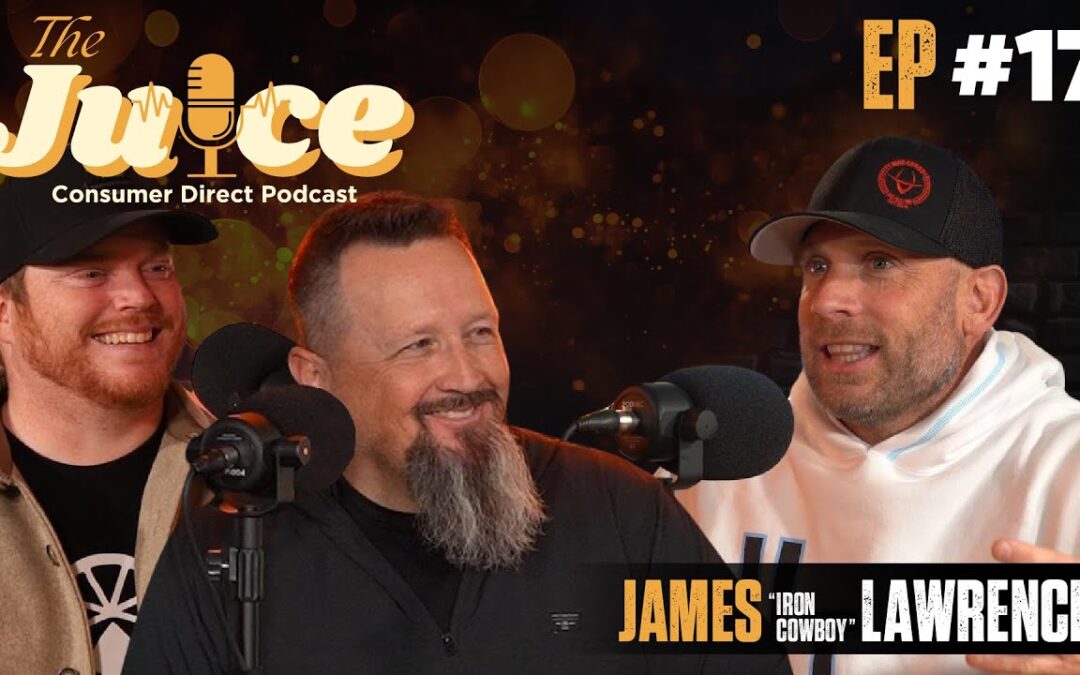
James "Iron Cowboy" Lawrence completed 100 consecutive Ironman triathlons in 100 days — and broke his back on day 59. Here's how he kept going, and what his ethos-driven approach means for anyone chasing a hard goal.
Listen wherever you get your podcasts
Key takeaways
- Mental toughness is built by showing up and taking action, not by consuming motivational content.
- Systems eliminate the daily decision to quit — dial your schedule in to the minute, just as Lawrence did during the Conquer 100.
- Write a personal ethos for every key role in your life so critical decisions are already made before chaos hits.
- Progress is incremental: Lawrence started with a four-mile fun run before ever attempting a consecutive Ironman series.
- Failures only stay failures until you extract the lesson and implement it — then they become stepping stones.
- Focus exclusively on what you can control; write your worries down and cross out everything outside your influence.
- Helping others win is the most reliable path to achieving your own goals — service creates success as a byproduct.
Who Is the Iron Cowboy?
James Lawrence earned the nickname “Iron Cowboy” by completing 50 consecutive Ironman triathlons across all 50 states in 50 days in 2015. Six years later, he doubled down: 100 consecutive Ironman-distance triathlons in 100 days — 2.4-mile swim, 112-mile bike, 26.2-mile run, every single day — accumulating 14,000 total miles. NBC Sports calls the Ironman “the most single difficult day in sports.” Lawrence did it for a quarter of a year straight.
The Physical Reality of the Conquer 100
The suffering was immediate. By day five, Lawrence had a stress fracture in his shin, staring down 95 more days of racing. Between days 5 and 15, the team scrambled for solutions until a carbon-plated shin brace manufacturer appeared on the run trail — drawn there, Lawrence says, by the decision to simply show up one more day.
On day 59, a violent bike crash knocked Lawrence unconscious and left him with a broken L5 vertebra and a bulging disc. His teammate Aaron brought him back to his feet not with a pep talk, but by reciting Lawrence’s own ethos back to him: had they finished what they started? Had they raised $250,000 to free sex-trafficking victims? Were they setting the best example for his kids? The answer to all three was no — so Lawrence got back on the bike.
Systems Over Motivation
Lawrence frames mental toughness not as a personality trait but as the output of deliberate systems — a point he grounds in James Clear’s Atomic Habits: “Our goals fall to the level of our systems.” During the Conquer 100, every minute of every day was pre-planned: swim intervals timed to 100 meters on the two-minute, nutrition laid out, departure times locked in. He challenges entrepreneurs and business owners to hold their calendars to the same standard.
- Reduce friction: Lay out clothes, queue up a playlist, write down the exact workout — the night before.
- Break it down: Turn off the alarm. Drink water. Roll out of bed. Put shoes on. Each step is its own action item.
- Reframe the obligation: Shift from “I have to work out” to “I get to work out.”
The Role of an Ethos
Lawrence’s most transferable concept is the ethos — a written, black-and-white declaration of who you are as a spouse, parent, business partner, and individual. Its purpose is to make hard decisions before the moment of chaos arrives, because, as he says from the stage, no good decision has ever been made at the peak of emotion. He recommends revisiting and revising your ethos as you grow.
Progress, Failure, and the Long Game
Lawrence’s endurance career began with a four-mile fun run where laughing moms pushing strollers passed him. He never went from zero to 100; he built through 10Ks, half-marathons, sprint triathlons, and full Ironmans across more than a decade. His core argument: you cannot see the next challenge until you’re ready for it, and readiness is built only by showing up. Failures remain failures only until you learn the lesson they contain — after that, they become the raw material of future success.
Control, Community, and What Actually Matters
Lawrence closes with a framework for anxiety: write down everything you’re worrying about, then cross out everything beyond your control. What remains — typically one or two items — is where your energy belongs. His final word: “There is no success outside your home that will ever compensate for failure inside your home.”
Hope is life and excuses are death — I give you something and I take something away.
— James Lawrence
I just need you to show up tomorrow and start, because we have no idea when the next miracle is going to happen.
— James Lawrence
No good decision has ever been made in the peak of emotion, chaos, or confusion — that's when bad decisions are made.
— James Lawrence
There is no success outside your home that will ever compensate for failure inside your home.
— James Lawrence
Episode chapters
- 00:11 — Introduction & Iron Cowboy's record-breaking résumé
- 01:47 — How the Conquer 100 broke James mentally — and neurologically
- 04:04 — Building mental toughness: why action beats inspiration
- 06:11 — Daily habits, gratitude, and the systems that replace motivation
- 12:54 — You can't go from zero to 100: the case for progressive challenge
- 23:15 — Hardest moments of the Conquer 100: stress fracture and the bike crash
- 27:59 — The ethos framework — making decisions before the chaos hits
- 33:10 — Presence, catastrophizing, and focusing on what you control
- 38:33 — Success as a byproduct of serving others
- 45:46 — Book, live event, and where to find Iron Cowboy
Frequently asked questions
Who is the Iron Cowboy?
James Lawrence, known as the Iron Cowboy, is an endurance athlete who completed 50 consecutive Ironman triathlons across 50 U.S. states in 50 days (2015) and 100 consecutive Ironman-distance triathlons in 100 days (2021).
How far is an Ironman triathlon?
A full Ironman is 140.6 miles total: a 2.4-mile swim, a 112-mile bike ride, and a 26.2-mile run. NBC Sports has called it the most single difficult day in sports.
What happened to James Lawrence on day 59 of the Conquer 100?
Lawrence was knocked unconscious in a violent bike crash. He later discovered he had broken his L5 vertebra and had a bulging disc, but continued and completed all 100 triathlons.
How does James Lawrence recommend building mental toughness?
Lawrence says mental toughness comes from taking action and learning as you go — not from podcasts or books alone. He emphasizes building systems, reducing friction, and starting with manageable steps.
What is James Lawrence's ethos framework?
An ethos is a written declaration of your values and commitments across key life roles — spouse, parent, business partner, individual. Writing it out in advance means your hardest decisions are already made before emotional moments arise.
Where can I watch the Iron Cowboy documentaries?
Both the 50/50/50 documentary and the Conquer 100 documentary are available on Amazon Prime under the Iron Cowboy title.