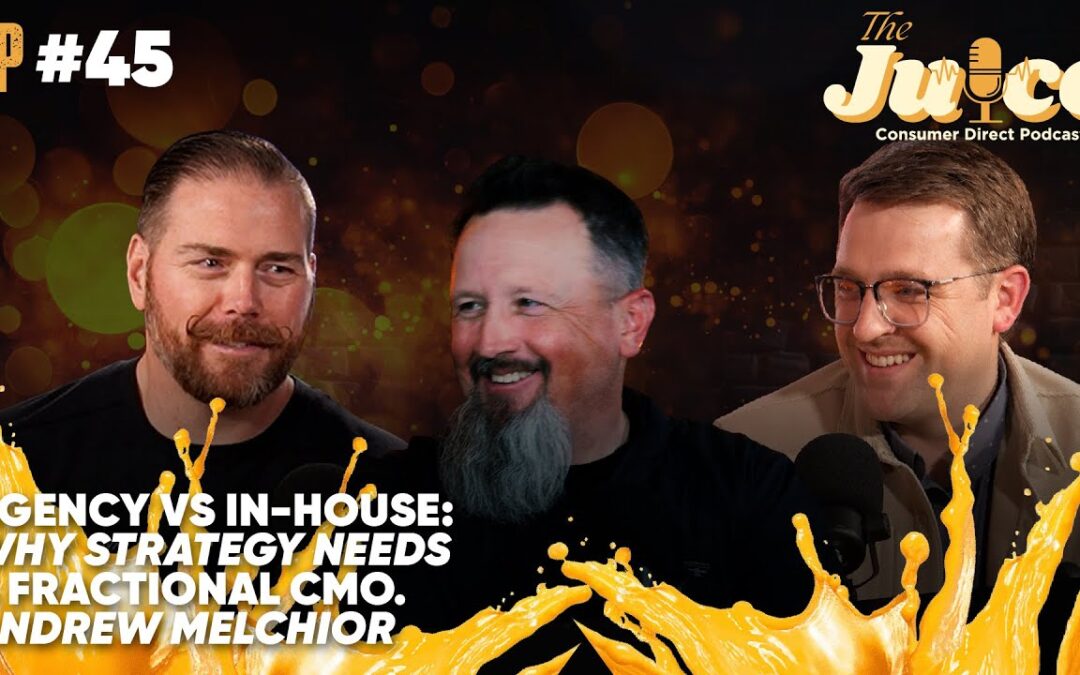
Most scaling companies between $10M and $100M in revenue don't have a marketing strategy problem—they have a leadership gap. Andrew Melchior, Co-Founder & COO of Avalaunch Media, explains how fractional CMOs and an "everything agency" model replace costly guesswork with accountable, revenue-driven execution.
Listen wherever you get your podcasts
Key takeaways
- Companies doing $10M–$100M in revenue frequently fall into 'random acts of marketing'—reactive, disconnected tactics with no strategic anchor.
- The average CMO tenure is 14 months, making a full-time hire costly and disruptive for most scaling businesses.
- A fractional CMO backed by a full-service agency team can dramatically outperform a solo in-house executive—one client moved from a 3:1 to a 16:1 return on ad spend.
- In-house marketing teams naturally lag behind agencies on cutting-edge strategy unless they maintain a strong culture of research and external learning.
- The Amplēo acquisition extended Avalaunch's fractional model beyond marketing to CFO, controller, HR, and tax compliance services.
- Avalaunch built an 'everything agency' by leaning into client demand rather than niching down—staffing each new capability with genuine specialists.
- Knowing when to refer a prospect rather than take the business is as important as knowing when to expand your service offering.
Why Strategy Is the Missing Layer in Most Marketing Programs
Companies doing $10M–$100M in annual revenue are often trapped in what Avalaunch Media calls “random acts of marketing”: a last-minute conference booth here, a Google Ads test there, a billboard with a six-week runway. Without a committed strategy anchored to lifetime value and cost-per-acquisition, these tactics rarely compound into growth.
Andrew Melchior, Co-Founder & COO of Avalaunch Media, traces this pattern to a structural problem: junior-level marketers reporting to a VP of Sales or a CEO, with no one in the building qualified to push back on bad expectations or set a real marketing roadmap.
The Case Against a Full-Time CMO at the $30M–$50M Stage
The average CMO tenure is 14 months. Add three to six months of onboarding and a formula rollout that may not fit the brand, and a company can easily spend $400,000 on executive marketing leadership and wind up back at square one. Melchior argues that most companies at this revenue stage simply don’t need—or get full value from—a full-time chief marketing officer.
The alternative: a fractional CMO embedded for eight hours a week, backed by a full-service agency team that already knows how to execute SEO, paid media, branding, content, email, and automation. One Avalaunch client saw their return on ad spend jump from 3:1 to 16:1 after making the switch.
Agency vs. In-House: What In-House Teams Miss
Melchior draws a clear distinction between in-house and agency exposure. An in-house team, unless it maintains a rigorous culture of research and conference attendance, naturally falls behind on emerging strategies. An agency managing millions of dollars across Google, YouTube, Meta, programmatic, radio, and print develops a cross-vertical pattern library that no single brand team can replicate.
- In-house teams often over-index on one channel that’s working and ignore the rest.
- Creative direction suffers when the internal point of contact—rather than a creative expert—drives the process.
- New C-suite hires import strategies from past companies that may not translate, then leave before results materialize.
How the Amplēo Acquisition Expands the Fractional Stack
Avalaunch’s acquisition by Amplēo—a Salt Lake City firm that started as a fractional CFO practice—created a broader fractional executive offering. Companies can now access fractional CMO, CFO, controller, HR, and sales-tax compliance support under one roof. The thesis is simple: the same logic that makes a fractional CMO cost-effective applies equally to every senior function a scaling business needs but can’t yet justify hiring full-time.
Building an “Everything Agency”—On Purpose
Avalaunch has spent 17-plus years resisting the conventional wisdom to niche down. When a major client threatened to leave unless they added paid media, they hired for it. That entrepreneurial instinct—find the gap, staff it with specialists, integrate it into the offering—has produced a full-service shop covering digital, traditional, branding, and now fractional executive leadership.
The guardrail: Melchior is equally clear about what Avalaunch won’t do. If they can’t confidently deliver at the level a client expects, they refer out rather than risk a brand-damaging failure.
They're just doing random acts of marketing. 'Oh, we need to drum up new business—let's try some ads on Google,' or 'let's throw up a billboard.'
— Andrew Melchior
The average tenure of a CMO is 14 months. For a scaling business doing 30, 40, 50 million a year—most of them don't even need a full-time CMO.
— Andrew Melchior
Fractional engagement, eight hours a week, backed by talent that actually knows how to do all the jobs. Best money they've ever spent.
— Andrew Melchior
If you don't build a strategy and anchor to that and then work that strategy, you're going to fall short on the marketing side—you're just zigging and zagging all over the place.
— Andrew Melchior
Episode chapters
- 00:10 — Introductions & Avalaunch's Branding Work for Squeeze
- 05:05 — Andrew's Origin Story: From Early 2000s Dotcoms to Agency Life
- 09:10 — Memorable Clients: Infographics, GoPro, and Salesforce
- 13:18 — Agency vs. In-House: Why In-House Teams Fall Behind
- 17:04 — Random Acts of Marketing and the Strategy Gap
- 20:07 — Fractional CMO Model: How It Works at Avalaunch
- 22:00 — The Amplēo Acquisition and the Fractional Executive Stack
- 25:21 — Real Client Case Study: From 3:1 to 16:1 ROAS
- 30:14 — Building the 'Everything Agency'—and Knowing When to Say No
- 33:29 — Squeeze's Evolution: Live Leads, AI Tools, and What's Next
Frequently asked questions
What is a fractional CMO and who needs one?
A fractional CMO is an experienced chief marketing officer who works part-time—often eight to fifteen hours a week—for a company that needs executive-level marketing leadership but isn't ready to justify a full-time hire. It's a strong fit for companies roughly in the $10M–$100M revenue range.
How does a fractional CMO compare to hiring a full-time CMO?
A full-time CMO averages only 14 months in role and spends the first three to six months learning the business before any strategy rolls out. A fractional CMO provides sustained strategic continuity at a fraction of the cost, especially when paired with an agency that handles execution.
What are 'random acts of marketing' and why are they a problem?
Random acts of marketing are disconnected, reactive tactics—a last-minute trade show booth, a short-run billboard, an untested Google Ads campaign—deployed without a coherent strategy. Because they lack a defined hypothesis, timeline, and success metric, they rarely produce measurable ROI.
What services does Avalaunch Media offer?
Avalaunch Media is a full-service 'everything agency' covering SEO, paid media (digital and traditional), branding, content, and creative. Through its parent company Amplēo, it also provides fractional CMO, CFO, controller, HR, and tax-compliance services.
What is Amplēo and how does it relate to Avalaunch Media?
Amplēo is a Salt Lake City-based firm that originated as a fractional CFO practice. It acquired Avalaunch Media to create a combined fractional executive services offering—pairing marketing leadership with financial, HR, and compliance support for scaling companies.
Should a scaling business use an agency or build an in-house marketing team?
Both have trade-offs, but agencies bring cross-vertical pattern recognition built across thousands of clients and millions of dollars in managed spend that most in-house teams can't replicate. A hybrid model—fractional CMO for strategy plus agency for execution—often outperforms either approach alone.