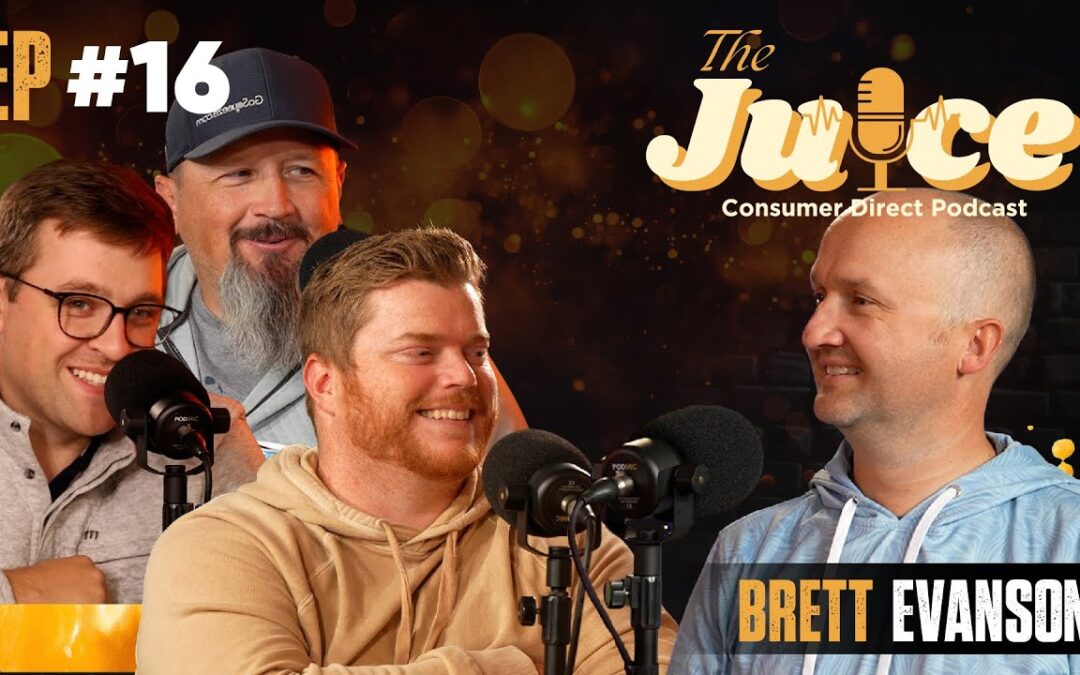
Squeeze CTO Brett Evanson joins hosts Carson Poppenger, Jacob Thorpe, and Justin Jump to unpack the proprietary PEEL AI platform, the company's build-vs-buy technology philosophy, and the sweeping industry changes arriving with the FCC/FTC one-to-one consent mandate in January 2025.
Listen wherever you get your podcasts
Key takeaways
- Squeeze built PEEL, a proprietary AI platform that scores call quality, agent performance, and customer sentiment using LLMs — without training its own model.
- Data centralization came first: automated scorecards and reporting only became possible after all operational data was unified in one source of truth.
- The FCC/FTC one-to-one consent rule takes effect late January 2025, ending the shared-lead brokerage model and requiring brand-specific consumer opt-ins.
- Squeeze developed SMS-based consent capture so agents can gather one-to-one consent in real time during a live conversation.
- A build-vs-buy framework guides every tech decision: proprietary strategic advantages are built; commodity needs are sourced off the shelf.
- Higher lead costs and market consolidation favoring large brands are expected unintended consequences of the new consent regulations.
- PEEL's model-agnostic architecture lets Squeeze swap underlying LLMs as the AI landscape evolves, protecting the investment from obsolescence.
Squeeze’s Tech Transformation: Automation, AI, and a Regulatory Reckoning
Brett Evanson, Squeeze’s Chief Technology Officer, brings a decade of lead-generation and call-center experience — including founding and selling Smart Rhino Labs in 2018 — to a company that, until recently, ran much of its operations on manual spreadsheets. In this episode he walks through the deliberate technology overhaul underway at Squeeze and what it means for clients, agents, and the broader consumer-direct industry.
From Manual Spreadsheets to a Custom Data Platform
Evanson’s first priority after joining was data centralization. Before automated reporting or AI analysis could exist, every relevant data point — agent performance, call outcomes, billing, payroll — had to live in one reliable source of truth. That groundwork enabled a rapid rollout of automated scorecards that replaced time-intensive manual payroll calculations and now serve as the operational backbone for agents and team leads alike.
- Centralized data architecture built for scalability — new features slot in without rebuilding from scratch.
- Automated scorecards eliminated significant manual labor hours and deliver agent pay data in near real-time.
- Security and scalability were built in from day one, not retrofitted.
PEEL: Squeeze’s Proprietary AI Engine
The platform generating the most excitement internally is PEEL (Performance Evaluation and Engagement Learning) — a machine-learning system that quantifies qualitative call data. What started as a quality-assurance tool to flag compliance phrases has evolved into a full intelligence layer that can analyze call recordings and transcriptions using large language models (currently Anthropic’s Claude) to surface insights no keyword-search tool could catch.
- Agent coaching: Scores are rolled up by agent, campaign, and team lead for targeted, actionable feedback.
- Client intelligence: When partners return transaction data, PEEL identifies which call behaviors correlate with conversions — on both the Squeeze side and the client’s sales floor.
- Customer sentiment: Brand-level sentiment data is delivered to marketing and brand officers who need to know how their customers actually feel on every interaction.
- Model-agnostic design: The system is built to swap underlying LLMs as better models emerge, avoiding the risk of training a proprietary model that could be obsolete within a year.
FCC/FTC One-to-One Consent: What Changes and When
The regulatory shift looming over the entire lead-generation industry is the FCC/FTC one-to-one consent rule, effective late January 2025. Under the new standard, a consumer’s opt-in on a web form grants contact permission to a single named brand — not a marketplace of undisclosed partners. Data brokerage of shared leads, once a standard monetization model, faces significant legal exposure after the rule takes effect.
- Squeeze has built SMS-based consent capture tools that allow agents to collect one-to-one consent in real time during a live call.
- Multi-step form flows with per-company disclosures are being evaluated as a compliant path for capturing consent for more than one brand.
- Lead prices are expected to rise as shared-lead efficiencies disappear; smaller brands face a steeper climb competing against recognized names for explicit consumer opt-ins.
- Evanson draws on prior TCPA revisions (2013, 2017) to predict a familiar pattern: gray-area operators exit, remaining players see higher-intent leads and ultimately better conversion rates.
Build vs. Buy: The CTO Framework
A recurring theme is Evanson’s disciplined build-vs-buy analysis: off-the-shelf software, by definition, offers no competitive differentiation. When a capability represents strategic advantage — as PEEL does — building a custom solution preserves the “secret sauce.” Beginning with the end in mind, mapping all required data points before writing a line of code, prevents the costly rebuilds that plague faster-moving but less-considered implementations.
If it's something that is a strategic advantage — this is like our secret sauce — you're much more likely to need to build that than get something off the shelf, because by definition if it's off the shelf everybody has it.
— Brett Evanson
We can take calls and call recordings and transcriptions and all this data and we can throw it at a model and ask it things in a more natural language way to be able to pull some things out.
— Brett Evanson
Constraint brings innovation — more problems bring unique solutions. This isn't the first TCPA revision that's happened.
— Brett Evanson
I don't want to get married to one model. Let's build tools that leverage the best models and hit our business objectives.
— Brett Evanson
Episode chapters
- 00:12 — Introductions & Golf Season Recap
- 09:33 — Brett Evanson's Background & Path to Squeeze CTO
- 15:53 — Automated Scorecards & Data Centralization
- 20:18 — Build vs. Buy: CTO Decision Framework
- 22:44 — Introducing PEEL: Squeeze's Proprietary AI Platform
- 26:36 — PEEL in Action: Agent Coaching & Client Intelligence
- 32:19 — FCC/FTC One-to-One Consent Rule Explained
- 34:22 — Technology Solutions for Consent Compliance
- 38:30 — Market Impact: Lead Costs, Brand Consolidation & TCPA History
- 43:13 — Closing Thoughts: Standardization, Automation & What's Next
Frequently asked questions
What is Squeeze's PEEL platform?
PEEL (Performance Evaluation and Engagement Learning) is Squeeze's proprietary AI system that analyzes call recordings and transcriptions using large language models to score agent performance, measure customer sentiment, and identify behaviors that drive conversions.
When does the FCC/FTC one-to-one consent rule take effect?
The rule is set to take effect in late January 2025 (around the 26th or 27th). Because many lead campaigns run 90-day call cadences, the practical impact on existing lead pools began in late October 2024.
What does one-to-one consent mean for lead generation?
Under the new rule, a consumer's web opt-in grants contact permission to one specific named brand only. Selling or sharing that lead data to multiple buyers is no longer permitted, effectively ending the traditional shared-lead brokerage model.
How is Squeeze helping clients comply with one-to-one consent requirements?
Squeeze built an SMS-based consent capture tool that lets agents send a form link during a live call, collecting explicit one-to-one consent on the spot before transferring the customer to a partner.
Why did Squeeze build PEEL instead of buying an off-the-shelf AI solution?
Off-the-shelf tools can't replicate Squeeze's specific business logic or integrate directly with its scorecard and billing systems. Building in-house also lets the team stay model-agnostic — swapping to better LLMs as they emerge without being locked into a vendor.
How will the one-to-one consent rule affect lead prices?
Lead prices are expected to rise because the shared-lead efficiencies that subsidized lower per-lead costs will disappear. Smaller brands may be disproportionately affected as consumers tend to opt in with the brand names they already recognize.